

Jesus last two statements or phrases from the cross were “It is finished” and “Into your hands I commit my spirit.” Today, we’re going to explore both of these final statements and the Gospel’s record of what happened in the Temple in Jerusalem as Jesus was dying on the cross. It’s very important we understand the significance of that, if we really want to understand what Jesus’ final words were all about…
Let’s get to them now as we go to today’s scripture verses—one from the Gospel of John (19:30a, NIV) and one from the Gospel of Luke (23:44-47, NIV)… Please listen:
When he had received the drink, Jesus said, “It is finished.” – John 19:30a (NIV)
It was now about the sixth hour, and darkness came over the whole land until the ninth hour, 45 for the sun stopped shining. And the curtain of the temple was torn in two. 46 Jesus called out with a loud voice, “Father, into your hands I commit my spirit.” When he had said this, he breathed his last. 47 The centurion, seeing what had happened, praised God and said, “Surely this was a righteous man.” – Luke 23:44-47 (NIV)
Palm Sunday is the time when we remember Jesus’ triumphal entry into the City of Jerusalem—a place where he knew full well that his end was coming. As a matter of fact, that was the very purpose of his life, that at the end he would go up to Jerusalem … which meant the purpose of his life would be fulfilled there … and it would end. (My thanks to our Middle Schoolers and their leaders who helped remind us of this event last week … and to all who waved palm branches as we entered into worship today.) So, Jesus came up to Jerusalem, he was arrested, he was crucified, and his last two statements are what we’re going to look at today… Let’s look closely at the first one:
IT IS FINISHED. All of the Gospels tell us thatsus ‘cried out’ in the end … but John tells us what Jesus cried out: “It is finished.” But, what does that mean? What is it that was finished or completed?
First of all, for some, these words of Jesus were an expression that his life was slipping away—a cry of defeat from a disillusioned prophet. A good example of this might be … the cry of a referee at a boxing match right after he’d given the 10-count. It’s over! That’s it, folks! He’s not getting back up! But, there’s a problem with this: You see, Jesus told his disciples on many occasions that he was going to Jerusalem to die. His arrest, torture, and crucifixion were no surprise! He’d come to Jerusalem for this very purpose … so it couldn’t have been a cry of defeat!
Another clue that these were not words of defeat can be found in the fact that Jesus “shouted” these words. Actually, he shouted just one word in Aramaic, recorded in John’s Gospel by one Greek word meaning, “Finished!” or “Completed!” One commentator (Will Willimon) described these words of Jesus as … something similar to what Michelangelo might have shouted while looking up at the Sistine Chapel right after his final brush stroke: “It is finished!”
So what happened was something astounding, amazing, and awesome was finished … as Jesus died on the cross—a masterpiece of love and redemption. But, again, what exactly was it that was completed on the cross? What did Jesus suffering and death on the cross really accomplish?
Both in college and seminary, I learned the historic ‘theories of the atonement,’ used at different points in history to explain Jesus’ death; you’ll be happy to know we don’t have time to go in-depth into these … to explain the it that was completed on the cross! Briefly, though, I’ll say that John’s Gospel gives us 7 different ideas or metaphors to explain the significance of Jesus’ death. Here’s just a sampling: Jesus’ death was…
An atoning sacrifice to save us from sin…
A substitutionary sacrifice to save us from death…
A demonstration of divine love for humanity…
A model Christians are meant to look to in practicing sacrificial love … and so forth (Go and study John!).
The other Gospels add to these metaphors and Paul uses several of the same metaphors to explain Jesus’ death … as our Redeemer, our Savior, our High Priest, our Paschal or Atoning Lamb, our Liberator—a King willing to die for his people…
Adam Hamilton describes the significance of Jesus death this way: “And through his death Jesus reveals to us our sinfulness, the costliness of his grace, and the magnitude of God’s mercy; on the cross he shows us what love looks like; in his death and resurrection, he identifies with our pain, suffering, and human mortality; and in his resurrection he proves that he’s overcome each of these—doing all of this to redeem, save, and draw humanity to himself.” THIS IS THE ‘IT’ THAT WAS FINISHED AS JESUS SHOUTED HIS DYING WORDS—what was completed on that day. That being said, I still think that Matthew, Mark and Luke explain it visually very well, when they add an important detail to this story: Folks,
THE TEMPLE SHOWS US JESUS’ WORDS WERE TRUE! Luke tells us something happens just before Jesus breathes his last; Matthew and Mark say it happens just after he breathes his last … but, in any case, we discover from both accounts that THE CURTAIN IN THE TEMPLE WAS TORN IN TWO!
The fact that 3 out of 4 Gospels record this detail is significant! So, let’s take a closer look at the Temple curtain…
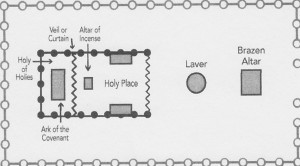
This diagram shows the inner court in the Temple in Jerusalem at the time of Jesus—perhaps a 10-minute walk from where Jesus was crucified…
The inner court was the court of the priests; no one else was allowed. They would go upstairs to enter the Holy Place, where they would offer incense on the altar of incense. The Holy of Holies, then, or the Most Holy Place … was considered the throne room of God. In ancient times, the Ark of the Covenant was kept inside the Holy of Holies.
The Ark of the Covenant (‘Raiders of the Lost Ark’) was a wooden box covered with gold that had two angels on top—one on each end. They were facing each other, with their faces bowed, and their wings meeting in the middle—as if to form a seat. This seat was called the Mercy Seat and was the throne of God. Inside the box, of course, were the 10 Commandments, a jar of manna—the food the Israelites ate in the wilderness, and the staff God gave to Moses and Aaron that had budded…
Once a year the High Priest would enter the Holy of Holies to offer sacrifices for his own sins and all the sins of God’s people. When this happened, the curtain or veil that separated the Holy of Holies from the Holy Place was lifted. But it was not some flimsy curtain. It was made of one piece of woven fabric—thought to be very thick and heavy. When the High Priest would enter the Holy of Holies annually, it would take several other priests to lift this curtain for him. Then, they would lower it back down until he was ready to come back out. No one else was allowed in that room but the High Priest!
Matthew, Mark and Luke all tells us that when Jesus died, this thick curtain separating the Holy Place from the Holy of Holies was torn in two. This was no small thing! It would have taken a violent act of tearing…
So, why did the Gospel writers think this was important to include in their accounts of Jesus’ death? The tearing of the Temple curtain was one more metaphor for what Jesus was accomplishing on the cross—the it that was to be finished. And most commentators believe that the tearing of the curtain in the Temple was a sign that, at his death, Jesus himself entered the Holy of Holies and made one final and perfect sacrifice to reconcile humanity to God. And from this time on, through Jesus sacrifice, human beings could now come directly to God (to the Mercy Seat) to ask for mercy and receive God’s grace. Jesus opened our way to God! For me, the detail of the curtain tearing helps explain the it that was finished much better than some of the other Gospel metaphors … so I’m so happy they included this. And finally, we’re given a great example of going directly to God as…
JESUS ENDS WITH A PRAYER (JUST LIKE HE BEGAN). After the Temple curtain was torn in two, Jesus offered one final statement … and, once again, his dying words were a prayer. Through this, Jesus shows us the importance of prayer. Here’s a review:
We noted that Jesus’ first words were a prayer: “Father, forgive them; for they do not know what they are doing” (Luke 23:34).
Around noon on crucifixion day, he prayed from Psalm 22: “My God, my God, why have you forsaken/abandoned me?” (Mark 15:34).
Then, at the end, Jesus offers one final prayer: “Father, into your hands I commit my spirit” (Luke 23:46, NIV). And these final words of Jesus are from another psalm which tells us that Jesus was probably silently reciting this psalm when he died. Here are the first 5 verses of Psalm 31 (1-5a, NIV):
In you, O LORD, I have taken refuge; let me never be put to shame; deliver me in your righteousness. 2 Turn your ear to me, come quickly to my rescue; be my rock of refuge, a strong fortress to save me. 3 Since you are my rock and my fortress, for the sake of your name lead and guide me. 4 Free me from the trap that is set for me, for you are my refuge. 5 Into your hands I commit my spirit….
This was Jesus’ dying prayer. It was a prayer of absolute trust in God. And just to recap … Jesus had forgiven his enemies, offered mercy to a thief, prayed for his mother, come to a place where he felt abandoned by God, and expressed his physical thirst; but before his death, he declared a shout of triumph: “It is finished!” Then he offered this beautiful prayer of absolute trust in his Heavenly Father…
That pretty much covers the final words of Jesus from the cross. And these, folks, are words to live by! Jesus taught us not only how to live, but how to pray…
Who of us doesn’t need to learn to pray for those who wrong us, “Father, forgive them….”
Who of us doesn’t need help in reaching out to seek and to save the lost … in Jesus’ name?
Who of us doesn’t need help in caring for our parents and our friends when they’re in need … Jesus’ way?
Who of us doesn’t need help getting through times where we feel abandoned, or thirsty—either physically or spiritually?
And who of us doesn’t need to be more thankful that Jesus was able to cry, “It is finished!”? We should be thankful every day for our salvation, because it’s certainly not what we deserved…
Folks, have you seen the LOVE from the cross? There is no one that has ever walked the face of this earth that could love YOU more! And that wasn’t just true 2,000+ years ago; it’s true today! Final words to live by, indeed…
Normal 0 false false false EN-US X-NONE X-NONE MicrosoftInternetExplorer4 /* Style Definitions */ table.MsoNormalTable {mso-style-name:”Table Normal”; mso-tstyle-rowband-size:0; mso-tstyle-colband-size:0; mso-style-noshow:yes; mso-style-priority:99; mso-style-parent:””; mso-padding-alt:0in 5.4pt 0in 5.4pt; mso-para-margin:0in; mso-para-margin-bottom:.0001pt; mso-pagination:widow-orphan; font-size:10.0pt; font-family:”Times New Roman”,”serif”;}